

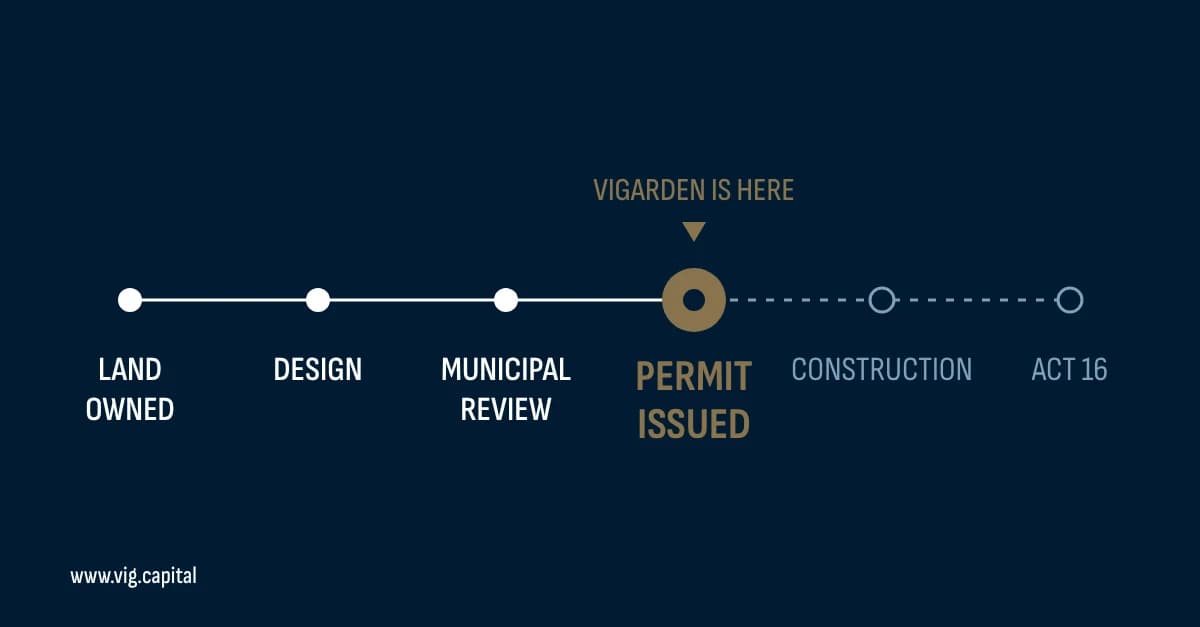
When investors look at a development project, most start with the return case. The ones who have done this before start with a different question: what's the permit status?
The return case is a projection. The permit is a document. And it's the document that turns a plan into a construction site.
What Happens Before the Permit
In Bulgaria, a building permit sits at the end of a long chain. The zoning has to be confirmed and the architectural design approved. Water, power and road connections have to be agreed with each utility. Several municipal departments have to sign off, and the design is checked against national and local planning rules.
None of this runs on the developer's timetable. Files wait in queues. Officials ask for revisions. Procedures get reinterpreted halfway through. It can take years, and it's the stage where Sofia projects stall most often.
All of that time is paid for with the developer's own capital.
What "Permit Issued" Changes for an Investor
If the permit is issued before investors come in, they aren't funding the permitting risk. The waiting, the uncertainty and the money spent getting through it have already been absorbed.
The investor enters at the point where the next step is construction, not administration. What remains is execution: build what the permit allows, on the approved budget and schedule.
Execution risk is real. But it's a different kind of risk. It can be measured, planned for and checked by people outside the developer.
The Bank as a Second Check
A bank doesn't commit to a development project on the developer's word. Before it closes a facility, it runs its own review of the project's economics, the site, the developer's record and the legal structure.
So a closed facility tells an investor two things. The project has passed an institutional review that the developer doesn't control. And a lender with its own capital at stake has decided the numbers hold.
The check doesn't stop at signing. During construction, the bank's own technical expert inspects the site before each drawdown and compares progress with the approved budget and schedule. Money is released only after that check. This is set by the financing contract, not by the developer.
What the Permit and the Bank Don't Remove
A permit and a bank facility don't make a project risk-free. Construction costs can still rise and sales prices can still move. Those are the risks the rest of your due diligence should test: the budget and its contingency, the sales plan, the stress case and where your capital ranks in the waterfall.
What these two documents do is let you test those risks on a project that's real.
Four Questions to Ask About Any Development Project
- Is the building permit issued? Not in process, not expected: issued.
- Does the project match the permit as issued, or will it need an amendment?
- Is the bank facility signed, rather than a term sheet or a letter of intent?
- Does the bank check progress on site before it releases money?
Ask for the document behind each answer. That includes us.
VIGARDEN · Sofia
26 Twin Houses at the Foot of Vitosha
- Permit issued
- Bank financing closed
- Construction from March 2027
The permit and the bank facility documents are in the VIGARDEN data room, available after an NDA.
Oleg KleinFounder & CEO, Vaisman Investment Group